

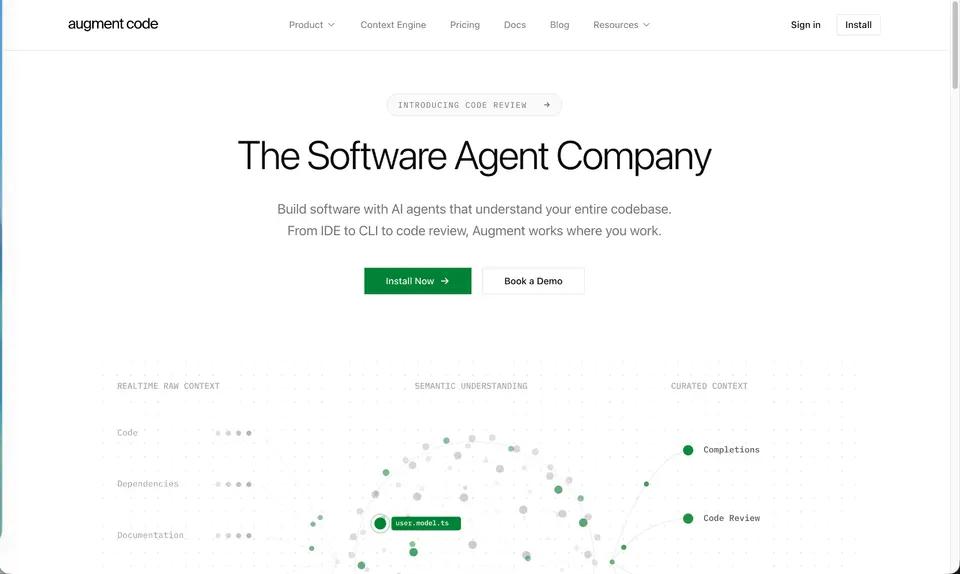
What is Augment Code?
Augment Code is an AI-powered software engineering platform designed for professional development teams. It provides AI agents that deeply understand your entire codebase through its proprietary Context Engine, enabling higher-quality code generation, review, and automation.
Unlike generic AI coding assistants, Augment focuses on full-codebase semantic understanding — including architecture, dependencies, documentation, and historical changes — to produce production-ready results.
Core Features
1. Context Engine
- Maintains live semantic understanding of your entire stack
- Analyzes code, dependencies, architecture, documentation, and history
- Curates relevant context from thousands of sources
- Enables higher correctness and best-practice alignment
2. IDE Agents
- Works inside VS Code & JetBrains
- Handles multi-step tasks
- Automatically remembers context across sessions
- Generates production-grade pull requests
- Performs structured edits with diff tracking
3. Code Review
- AI-powered senior-level reviewer
- Inline GitHub comments
- High precision and recall benchmarking
- Identifies logical errors, style mismatches, and architectural issues
- One-click fixes in IDE
4. CLI (Terminal Agent)
- Full terminal integration
- Works with your existing shell
- AI-powered coding via command line
- Supports prompt automation via
auggie --print - Same Context Engine as IDE agents
5. Completions & Next Edit
- Context-aware code suggestions
- Aligns with project-specific patterns
- Minimizes technical debt
6. Remote Agents
- Agents that can operate beyond local IDE workflows
7. Slack Integration
- AI interactions within team communication workflows
Key Differentiators
- Deep semantic codebase understanding
- Production-grade output (not “AI slop”)
- Blind benchmark studies vs. other tools
- Context-aware code reuse
- Best-practice alignment to specific codebases
- Designed for professional engineering teams
Performance Claims
Based on a blind study comparing 500 agent-generated pull requests to human-written merged code on the Elasticsearch repository (3.6M LOC):
Measured across:
- Functional correctness
- Completeness
- Code reuse
- Best practice alignment
- Context awareness
Augment reports superior aggregate performance versus other AI coding tools.
Use Cases
1. Large Codebase Development
- Enterprise monorepos
- Complex architectures
- Multi-team collaboration
2. Feature Implementation
- Multi-step feature development
- Rate limiting, middleware, APIs, integrations
3. Code Review Automation
- Catching critical bugs
- Maintaining style consistency
- Architecture validation
4. Terminal-First Engineering
- CLI-based development workflows
- DevOps and backend engineers
5. Refactoring & Technical Debt Reduction
- Code reorganization
- Dependency cleanup
- Pattern alignment
6. Continuous Engineering Support
- Persistent project memory
- Cross-session intelligence
Target Audience
- Professional software engineers
- Engineering teams
- Enterprise organizations
- Companies with large or complex codebases
- Teams using VS Code or JetBrains IDEs
Trusted by companies including: MongoDB, Spotify, Snyk, MoneyGram, Crypto.com, Webflow, and others.
FAQ (Inferred from Page Content)
Q1: How is Augment different from other AI coding tools?
Most AI tools use similar models. Augment differentiates itself through its proprietary Context Engine, which deeply understands the entire codebase.
Q2: Does Augment work only in IDEs?
No. It works in IDEs (VS Code, JetBrains), in the terminal via CLI, in GitHub for code review, and integrates with Slack.
Q3: Is it suitable for large codebases?
Yes. It is built to handle monorepos and enterprise-scale projects.
Q4: Does it support automation?
Yes. The CLI supports automation commands like auggie --print.
Q5: Does it integrate with GitHub?
Yes. It provides inline comments and code review functionality within GitHub pull requests.
Q6: Is it meant for individual developers or teams?
Primarily professional engineering teams, but it works for projects of any size.
If you'd like, I can also generate:
- A competitor analysis vs Cursor / Claude Code
- A product positioning summary
- A landing page teardown
- A GTM (go-to-market) breakdown
- Or a structured JSON output version for automation purposes 🚀


